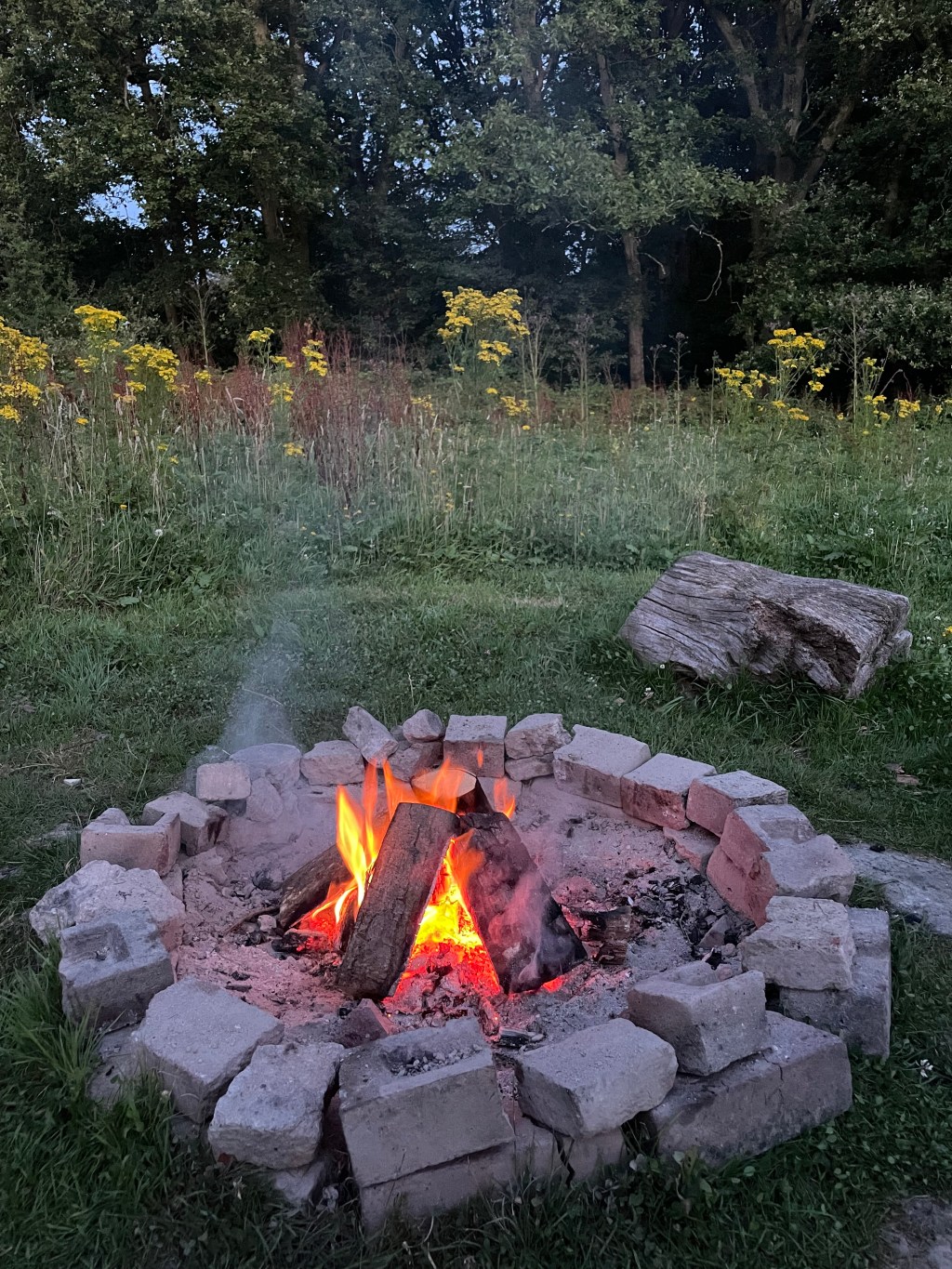
I recently got back from camping in the Sussex countryside, tucked away in a meadow where we had our own clearing to ourselves, surrounded by trees and grass and wildflowers, with bunnies bouncing around in the early morning. It was bliss. Just the colours of nature, the sound of birdsong, no screens, no work, no real signs of modern life.
We pottered around the campsite, visited local beaches, and went for country walks. Evenings were spent around the campfire gazing into the flames or gazing up into the sky at the thousands of stars twinkling in the silence. There’s no other experience I find as calming as this.
But then I came back to London, and it always feels so horribly unnatural. Too much concrete, too many cars, not enough green. The shift is physical: my shoulders tense, my breathing gets shallower, my brain feels like it starts whirring again on a higher, harsher frequency. It always makes me think of that Joni Mitchell line about paving over paradise to put up a parking lot. I can almost feel the grass and the wildflowers and the bees humming underneath the grey pavements, smothered by asphalt. There’s too much noise and my attention is being pulled in all directions at once.
What must it do to your brain to live in today’s world, and especially in a big city like London? Moving constantly between screens, emails, messages, notifications. I love music so I usually have the radio playing in the background, but it adds another layer of stimulation on top of the neighbours’ chatter, the voices of passersby on the street, the sirens and bin lorries, the souped-up cars speeding by. Even when I’m sitting at home with the windows closed, there is a low hum of sound that never stops. The air itself feels heavy, thick with pollution I can’t see but know is there.
And I think about my dad. He has dementia, and I can’t help wondering: how much of this contributes? How much did the constant overstimulation, the stress of modern life, the polluted air play a part? According to Alzheimer’s Research UK, addressing 14 health and lifestyle factors throughout our lives could prevent or delay nearly half (45%) of dementia cases — things like physical inactivity, high blood pressure, poor diet, smoking, and air pollution. Which means that where and how we live is not just background to our lives, but an active force shaping our future brains.
I think about how my dad couldn’t join us on the camping holiday to the meadow. He would have loved the peace of it, the quietness, the birdsong. But dementia keeps him tethered — to routine, to familiarity, to a smaller world. That absence feels very sharp when I’m somewhere beautiful, and I can picture how much he would have smiled being there with us.
When you have a parent with dementia, you’re constantly worrying about whether you’ll get it yourself when you’re older. Every lapse in memory, every moment of brain fog feels like a sign. And I feel brain fog all the time as a woman in my forties, juggling too many tasks in too little time. The endless list: childcare through the long summer holidays, work deadlines, planning the return to school, trying to get some exercise in, making sure I eat enough protein, fibre, fruit and veg. My mind feels like it’s always spinning, never pausing.
In my twenties, health was about whether I looked good in a swimsuit. Now it feels far more urgent. Good diet and exercise aren’t vanity — they’re about whether I’ll be able to think clearly in 30 years. About whether I’ll still be myself. Knowing my dad has dementia makes me feel I can’t afford to mess around with my body anymore. It feels like I must control what I can, even if the bigger risks — pollution, stress, the relentlessness of modern life — are harder to hold back.
Right now, though, it often feels like I’m failing. My brain is like a stack of papers about to topple over. My brain is like an overfilled bin in a student house that nobody wants to empty, so you balance your apple core gently on top and creep away. My brain is a car with its wheels stuck in mud, spinning and spinning but not moving anywhere.
Sometimes I wonder if living in a city is accelerating this. Maybe humans were never meant to live surrounded by this much concrete and sound. Maybe that’s why time in nature feels like such a deep reset — because it’s how our brains evolved to rest, in birdsong and starlight, not in sirens and screens.
I don’t have a lot more to say this week, because I’m running to catch up with work, but this is what’s been sitting in my head since coming back from the meadow. Along with everything else — the long to-do lists, the invisible pressures, the constant juggle. My mind is noisy even when the room is quiet.
And I can’t help asking: what is all this doing to us? To our brains, to our futures?
 dementia in the family
Leave a comment